Global Pipeline Knowledge
3LPE Coatings vs. FBE: Choosing Protection for Rocky Pipeline Backfill
For rocky pipeline backfill, 3LPE coatings are often the stronger starting point when installation damage is the main concern. Their polyethylene outer layer provides additional mechanical protection over the corrosion barrier. Single-layer fusion-bonded epoxy (FBE) can still be a sound choice where padding, handling, and backfill placement reliably control contact with sharp rock. Neither system makes uncontrolled dumping of angular material acceptable.
The decision depends on how the coating will be loaded during construction and throughout service. A falling stone, a sharp rock pressed against the pipe, and abrasion during lowering-in create different damage mechanisms. Operating temperature, cathodic protection, and field-joint quality can also change which system offers the more dependable overall result.
What the coating layers actually contribute
FBE is an epoxy powder applied to prepared, heated steel and cured into a bonded protective film. Its main job is to isolate the steel from the surrounding environment. Performance depends on surface preparation, application conditions, cure, continuity, and adhesion. A well-applied coating can still suffer mechanical damage during transport or installation.
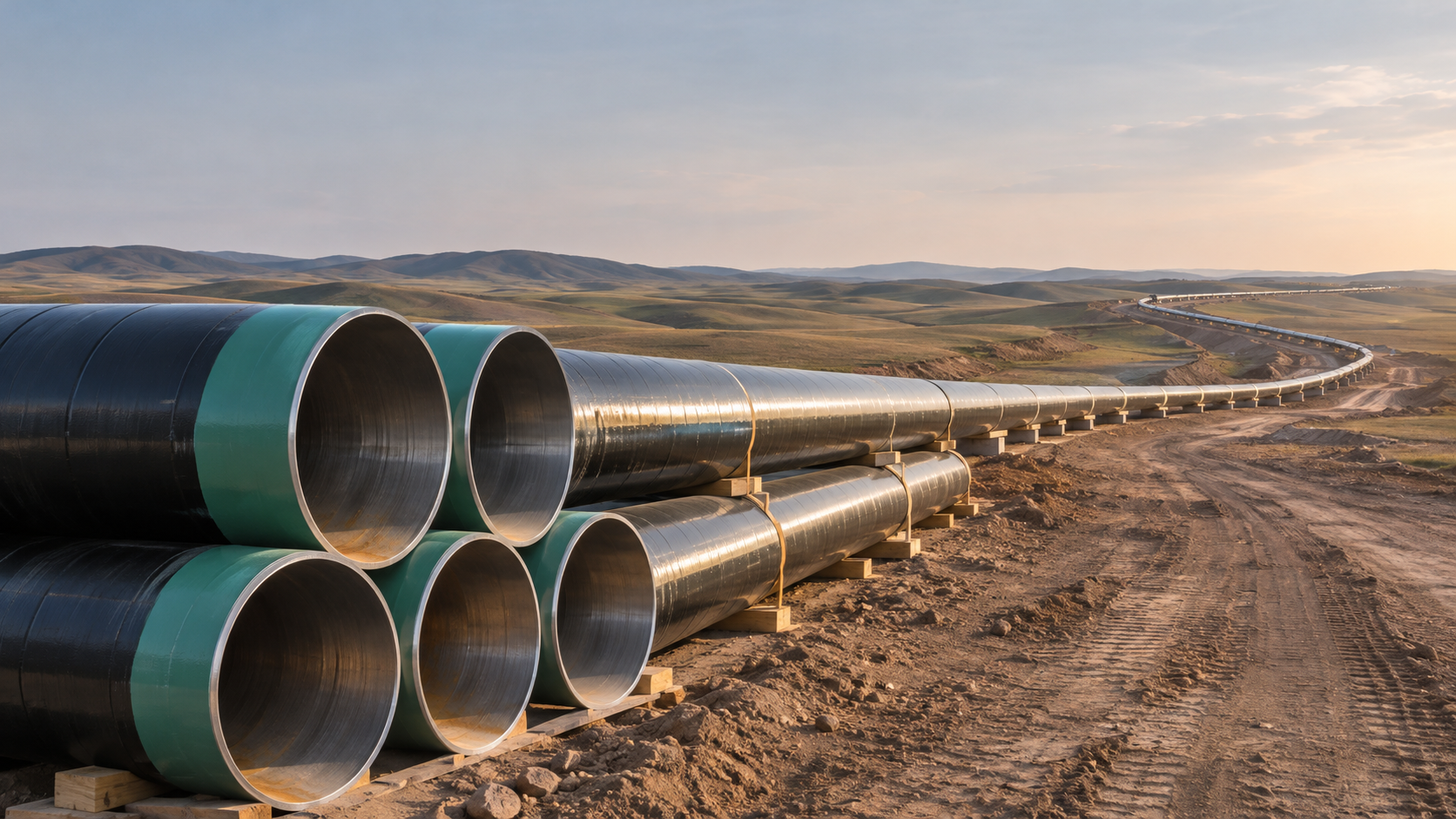
A three-layer polyethylene system combines an FBE primer, an adhesive layer, and a polyethylene outer layer. The primer provides the bond to steel and the underlying corrosion barrier; the adhesive connects it to the polyethylene, which adds mechanical protection and resistance to moisture ingress.
This construction generally gives 3LPE more tolerance to handling abrasion and impact than conventional single-layer FBE under comparable conditions. However, outer-layer thickness alone does not establish resistance to sharp-rock penetration. Polyethylene formulation, temperature, contact geometry, loading duration, and the integrity of the interfaces all affect performance.
Also establish what a supplier means by “FBE.” Single-layer FBE, dual-layer FBE, and FBE with a separate abrasion-resistant overcoat are different options. A proposal offering additional mechanical protection should be assessed as that complete system, rather than grouped with ordinary single-layer epoxy.
Separate falling-rock impact from long-term indentation
“Rocky backfill” is too broad to serve as a coating specification. Rounded gravel placed gently around the pipe creates a different exposure from angular blasted rock tipped from height. Describe the material, its shape, its placement, and the support conditions beneath the pipe before comparing coating offers.
Impact damage occurs when material strikes the coating. Stone mass, drop height, and the shape of the contact point influence whether the coating dents, cracks, or is penetrated. A laboratory impact result is useful only when its test conditions represent a meaningful challenge for the proposed installation.
Indentation develops when a rock remains pressed against the coating. Backfill pressure, pipe movement, and local support conditions can maintain that load. Polyethylene can deform under sustained pressure, with behavior affected by temperature and time. A coating that withstands a short impact may still require protection against prolonged contact with a sharp rock.
Abrasion adds another exposure during dragging, lowering-in, or movement against trench material. Damage may initially affect only the polyethylene surface, but deeper gouges can compromise the underlying layers. Inspection must distinguish superficial marking from damage requiring repair under the project criteria.

These differences explain why a single “high impact resistance” claim cannot settle the selection. The qualification evidence needs to address the relevant combination of impact, indentation, abrasion, and temperature.
When padding changes the coating decision
Padding is part of the protection system. Suitable selected material around and beneath the pipe can reduce direct contact with sharp particles and distribute local loads. Its value depends on whether it can be installed continuously, including at the underside of the pipe, field joints, bends, and trench irregularities.
Where screened material is available and placement can be controlled, single-layer FBE may offer a practical solution. The evaluation then rests heavily on construction discipline: preventing damage during handling, maintaining the specified embedment, and inspecting accessible coating before burial.
Where angular rock is widespread, handling is demanding, or reliable padding is difficult to maintain, 3LPE may provide useful additional tolerance. That advantage does not justify eliminating padding automatically. Large, sharp rock can impose loads beyond the capability of either coating system.
Rock shields and other protective materials can address specific exposures, but their design also needs evaluation. Check how they distribute load, remain in position during backfilling, interact with the coating, and affect cathodic protection current paths. An added protective layer should have a defined function and suitable qualification evidence.
Temperature and cathodic protection can change the preference
Use the full temperature envelope, including construction exposure, normal service, shutdown conditions, and credible excursions. The temperature relevant to external coating performance may differ from the nominal fluid temperature, depending on the installation and heat transfer conditions.
For 3LPE, evaluate the primer, adhesive, polyethylene, and their interfaces together. Higher temperatures can affect deformation under load and adhesion performance. At low installation temperatures, impact behavior and handling precautions also deserve attention. FBE likewise needs a formulation qualified for its intended thermal duty; the coating name alone establishes no operating limit.
Cathodic protection provides another reason to look beyond mechanical strength. It supplements the coating by supplying protective current to exposed steel where the surrounding electrolyte provides a current path. If coating disbonds while remaining over the steel, it may restrict that path and create a shielded area.
Disbonded polyethylene layers can create shielding conditions, so retained adhesion and resistance to disbondment matter throughout the coating system. FBE should not be treated as universally immune to shielding or disbondment. Its behavior depends on formulation, aging, adhesion, and the geometry of the damaged area.
Review cathodic disbondment evidence alongside adhesion, aging, and mechanical results. A favorable result under one laboratory condition does not establish performance across every service temperature or defect condition. Coating qualification and cathodic protection design should therefore use consistent assumptions about the intended duty.
Ask for qualification evidence that represents the project
A supplier’s standard data sheet is a starting point. A useful technical submission connects each reported result to the proposed coating build, application process, substrate preparation, and exposure conditions. Results from a different formulation or layer arrangement may offer limited support for the supplied system.
The purchasing specification should identify the applicable coating standard and edition, relevant test methods, and project acceptance criteria. This prevents bids from appearing equivalent when they use different test conditions or acceptance rules.
For a rocky route, focus the review on evidence that answers practical questions:
- Impact and indentation: What were the test temperature, contact geometry, loading conditions, duration, and failure criteria?
- Adhesion: Was performance assessed initially and after relevant conditioning? For 3LPE, which interface failed, and how was that failure judged?
- Cathodic disbondment: Do the temperature, duration, and test conditions support the intended service assessment?
- Application quality: How are surface cleanliness, surface profile, application conditions, cure, and layer continuity controlled?
- Thickness: Are minimum requirements defined for the individual layers where relevant, including areas that are harder to coat uniformly?
- Repairs: What damage is repairable, which repair materials are qualified, and what inspection follows repair?
Keep laboratory qualification separate from production acceptance. Qualification demonstrates that a defined system can meet specified requirements. Production inspection establishes whether the delivered pipe was coated consistently within the approved process.
Holiday detection checks for electrically detectable discontinuities through the coating to the steel. It does not measure adhesion, demonstrate indentation resistance, or identify every form of outer-layer damage. Test settings and procedures must suit the coating system and thickness.
Field joints and construction inspection deserve equal weight
The factory coating ends at each pipe joint. The completed pipeline therefore includes repeated transitions between factory-applied material and a field-applied system. Strong pipe-body protection can be undermined by poorly prepared, inadequately cured, or mechanically vulnerable joints.
For 3LPE-coated pipe, assess compatibility with the polyethylene overlap area and exposed steel, as well as the joint system’s resistance to the expected backfill loads. For FBE-coated pipe, evaluate the field-applied material and its construction requirements independently; factory performance does not automatically transfer to field application.
Check whether the construction method can deliver the required surface preparation, preheating, environmental control, application, and inspection. Include realistic curing or cooling time before handling and burial. A joint system that performs well under controlled conditions may become a schedule constraint if its application requirements are omitted from planning.
Inspection should follow the damage opportunities. Receiving inspection can identify transport damage; checks after bending and handling address later damage; accessible coating inspection before lowering-in and backfilling helps prevent known defects from being buried. Backfill placement controls remain necessary because damage can occur after the final accessible inspection.
Make the selection around the installed system
Compare the installed cost of protection, including coating, transport precautions, padding, supplementary protection, field joints, repairs, inspection, and construction time. A lower coating price may depend on more demanding backfill control. A mechanically stronger coating may still need selected embedment and careful joint treatment.
A defensible decision follows a short sequence:
- Define the exposure: characterize rock shape, likely contact loads, placement method, trench support, temperature, and soil conditions.
- Set construction controls: establish padding, handling, lowering-in, and backfill practices that the contractor can consistently deliver.
- Compare complete systems: assess factory coating, field joints, repairs, additional protection, and cathodic protection together.
- Connect evidence to acceptance: specify qualification conditions, production checks, damage limits, and repair requirements before procurement.
For angular rocky backfill with demanding handling conditions, 3LPE deserves serious consideration because its outer layer adds mechanical protection. Single-layer FBE remains a credible option where temperature requirements, qualified coating performance, and dependable embedment controls support it. If sharp-rock contact cannot be controlled, revise the backfill or protection design before treating either coating as the solution.
Related Industries
Trending in Tech
 Subsea Anode Retrofit Clamps: Sizing for Corrosion Protection LifeNov 06, 2026
- Global Project Radar: Tracking Pipeline Projects From Bid to AwardNov 06, 2026
- High-Frequency Induction Welded Pipe: Weld Quality and Heat InputNov 06, 2026
- Double Submerged Arc Welded Pipe: What to Check Before OrderingNov 06, 2026
Weekly Insights
Stay ahead with our curated technology reports delivered every Monday.
Questions about pipe blasting or corrosion protection? Leave a message for technical insights from GPIC.
We respect your privacy. Your information is strictly confidential.
Recommended News