Global Pipeline Knowledge
Double Submerged Arc Welded Pipe: What to Check Before Ordering
Double submerged arc welded pipe can be a suitable purchase for demanding pipeline projects, but a quotation based only on diameter, wall thickness and steel grade leaves too much open to interpretation. Before ordering, buyers need to establish the required product specification, manufacturing route, inspection scope and delivery conditions, then check that each offer covers the same work.
The first commercial decision is whether the proposed pipe and evidence package fit the duty. A lower-priced offer may be competitive because it uses an acceptable alternative manufacturing route, but it may also omit supplementary testing, weld-end preparation or documentation required by the project. Those differences should be resolved before bids are ranked, when changes are less likely to affect production slots or delivery.
Define the duty before comparing pipe offers
Start with the conditions that govern pipe selection: the transported fluid, design pressure and temperature, route, installation method and applicable regulatory requirements. The purchaser should obtain the approved pipe design and material requirements from the responsible engineering team rather than use a supplier’s nominal grade as a substitute for design verification.
Diameter and wall thickness influence more than the mass of steel being bought. They affect mill capability, dimensional control, inspection methods, handling and field welding. Installation loads and strain, local terrain, water depth and fracture-control requirements may also affect the purchase specification. For corrosive fluids, the material and testing requirements need to reflect the actual service; a standard line-pipe grade alone does not establish suitability for sour service.
For an API 5L order, state the applicable edition, product specification level, grade and delivery condition, together with any project-specific supplementary requirements. API 5L may be appropriate for line pipe, but it is not the only possible specification. The contract should identify the governing standard and edition rather than rely on a generic statement that pipe is “made to standard.”
Also separate requirements that are essential from preferences that can be evaluated as alternatives. A mill can then price the mandatory scope consistently while identifying any proposed deviations. Without that separation, the cheapest offer may simply be the one that interpreted an ambiguous specification most narrowly.
Specify the manufacturing route and the evidence required
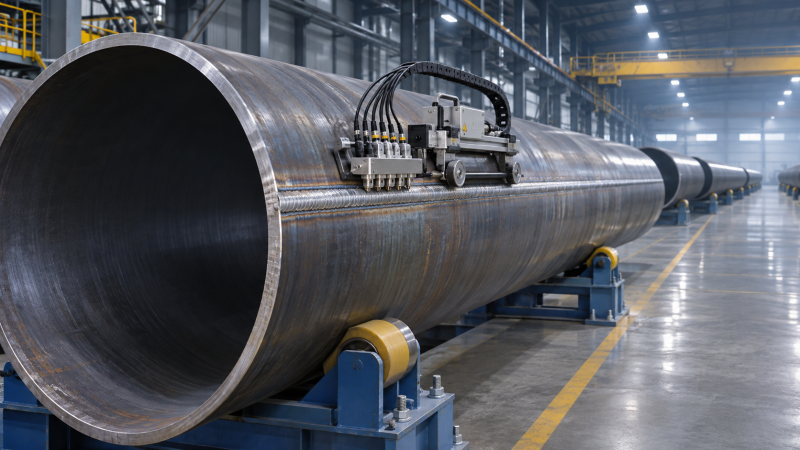
Double submerged arc welding refers to weld metal deposited from both the inside and outside of the pipe. The term describes a welding approach; on its own, it does not define the pipe’s grade, seam configuration, inspection coverage or acceptance criteria. Buyers should ask each bidder to identify the proposed manufacturing process, including whether the seam is longitudinal or helical, and the mill and production location where the order would be made.
Do not assume two routes are interchangeable merely because both offers use the same grade and dimensions. The project specification may restrict seam configuration or impose different requirements on weld inspection, dimensional control, repair and qualification. If an alternative route is offered, it should be submitted as a documented deviation for engineering review, with its price and schedule effects shown separately.
Ask for a manufacturing and inspection plan specific enough to show how the order will be controlled. It should identify the main forming and welding stages, inspection points, applicable procedures and proposed subcontractors. Where the bid relies on capacity at a particular mill, confirm that the mill can produce the required diameter, thickness, grade and order quantity together; capability in one dimension does not establish capability for the full combination.
Expansion, sizing, seam repair and weld-end preparation can affect downstream fit-up and inspection. The purchase specification should state any restrictions on these operations and the records required. If repairs are permitted, agree the governing procedure, acceptance criteria and reporting requirements before production, rather than leaving their treatment to a later commercial dispute.
Ask what “inspected” includes
A promise that the weld will be inspected is too broad for bid comparison. The order should identify the required non-destructive testing methods, inspection coverage, procedure and acceptance criteria under the governing specification and project requirements. It should also state how indications are evaluated, when reinspection is required and what happens to pipe that does not meet acceptance criteria.
Similarly, establish the applicable requirements for hydrostatic testing, dimensional checks and mechanical testing. The standard and product specification level may define a baseline, while the project may add tests or tighter criteria. Purchasers should have engineering identify these additions explicitly, including sampling, locations, testing frequency and witness or hold points where required.
Inspection coverage is a recurring source of apparent savings. An offer that prices only the baseline requirements should not be compared directly with one that includes additional seam inspection, enhanced toughness testing or purchaser witness activities. Request an itemized price for each required addition and identify any excluded test, procedure qualification or third-party attendance.
Check dimensions at the points that affect construction
Nominal outside diameter and wall thickness are essential order data, but construction crews work with actual pipe ends and actual tolerances. The purchase specification should address applicable limits for diameter, ovality, wall thickness, straightness, length and end squareness. It should also define bevel geometry and any requirements for internal or external end preparation.
These details affect field fit-up, welding productivity and the risk of rework. Tight tolerances can add manufacturing or inspection cost, so they should be linked to a project need rather than included without review. Conversely, relaxing end tolerances to reduce mill cost can transfer expense to the construction contractor. The buyer should ask engineering and construction teams which dimensions are particularly important for the planned welding method and installation sequence.
Length is also a commercial variable. State the acceptable length range, how quantities will be measured and whether short lengths are permitted. A price per tonne can look attractive while producing a different delivered length from an offer priced per metre. Normalize bids using the same quantity basis and account for permitted length variation, specified wall thickness and any applicable quantity tolerance.
Compare the delivered cost, not just the mill price
The useful comparison is the cost of pipe that meets the purchase specification and arrives in a condition suitable for the next project stage. Build a common bid schedule around the same technical and logistical scope. At minimum, separate the following:
- Pipe manufacture: grade, dimensions, seam route, quantities and any permitted tolerances.
- Testing and inspection: baseline requirements, supplementary tests, independent inspection and purchaser attendance.
- Finishing: end preparation, marking, protection, preservation and any required handling provisions.
- Coating interface: whether pipe is supplied bare or coated, and who is responsible for transport and acceptance at the coating facility.
- Delivery: named destination, delivery terms, shipment sequence, packaging and allocation of freight, insurance and unloading costs.
- Documentation: certificates, test reports, traceability records and the timing and format of submissions.
Ask bidders to price deviations and optional work separately. A supplier may offer a shorter lead time for an alternative route or propose a different inspection arrangement. That can be commercially valuable, but only after the technical authority has accepted the alternative and its effect on the rest of the supply chain is understood.
Schedule deserves the same scrutiny as price. Establish when the delivery period starts, whether the quoted capacity is reserved, and which approvals or materials are prerequisites for production. A date for completion at the mill is not the same as a date at the coating plant or construction site. For phased construction, agree the release sequence and minimum shipment quantities; receiving the entire order late may be more disruptive than receiving part of it early.
Protect traceability through coating and delivery
Documentation should connect each delivered pipe length to its material and manufacturing records as required by the purchase specification. Define the marking system, certificate content and handover format before manufacture. The buyer should be able to reconcile the shipment against the order and locate the relevant test records without relying on informal correspondence.
Clarify how identification will be maintained if pipe is cut, repaired, coated or transferred between contractors. Coating can obscure markings, and handling between the mill, coating plant and site creates several opportunities for identification or physical protection to be lost. Responsibilities for inspection at each handover, damage reporting and acceptance should be assigned in the contract.
Where external coating is in scope, check that pipe surface condition, weld profile and end cutback requirements are compatible with the coating specification. If coating is a separate contract, the pipe supplier and coater still need an agreed interface for receipt condition, storage and treatment of damage. A problem discovered after coating can be more expensive to investigate and correct than one identified at the mill.
Before award, close the bid tabulation with a written deviation register and an agreed inspection and documentation scope. The purchase order should reflect the accepted offer, the governing specification and the required delivery interfaces. That gives the project a defensible basis for comparing cost now and accepting the pipe when it arrives.
Related Industries
Trending in Tech
 Subsea Anode Retrofit Clamps: Sizing for Corrosion Protection LifeNov 06, 2026
- Global Project Radar: Tracking Pipeline Projects From Bid to AwardNov 06, 2026
- High-Frequency Induction Welded Pipe: Weld Quality and Heat InputNov 06, 2026
- Double Submerged Arc Welded Pipe: What to Check Before OrderingNov 06, 2026

Weekly Insights
Stay ahead with our curated technology reports delivered every Monday.
Questions about pipe blasting or corrosion protection? Leave a message for technical insights from GPIC.
We respect your privacy. Your information is strictly confidential.
Recommended News